Connector SDK & CLI
To enforce zero trust policies based on Principal identity and live data attributes, Caber connects to external enterprise systems across four domains:
- SaaS Application Event Logs and Activity Streams (audit and activity feeds from Slack, GitHub, Jira, Confluence, Salesforce, Google Workspace, and Microsoft 365)
- External Identity Providers (user, group, role, and OBO delegation mappings from Okta, Microsoft Entra ID, AWS IAM Identity Center, Keycloak, and SPIFFE or SPIRE)
- Metadata and Data Catalog Sources (classification labels, sensitivity tags, and data ownership records from Collibra, Alation, Apache Atlas, Snowflake Horizon, and AWS Glue)
- Object and Document Storage Sources (enterprise corpora in Amazon S3, Google Cloud Storage, Azure Blob Storage, SharePoint, Google Drive, Box, and relational or vector stores)
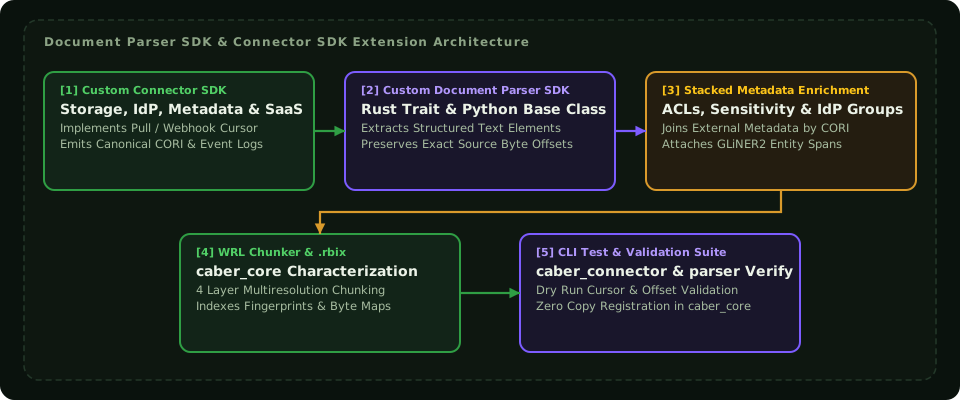
Caber connectors operate as standalone ingestion agents or in process service tasks that bridge enterprise systems to the core Rust processing engine (caber_core and streaming_core).
Data Filtering & Normalization
- VRL Transformation: Ingestion feeds apply Vector Remap Language (
vrl_engine) scripts to strip noise and normalize proprietary vendor JSON into canonical Caber event envelopes. - Pre Filter Rules: Connectors can drop unmonitored event types, non document file extensions, and healthcheck noise before allocating memory envelopes.
Connector Configuration
Connectors are declared under CONFIG_SCHEMA.json inside sections Identity_Sources, Object_Sources, and Metadata_Sources. Each connector instance specifies:
enabled(boolean): Activation state.sync_interval_seconds(integer): Polling frequency for batch or cursor endpoints.credential_ref(string): Secret name in AWS Secrets Manager or local environment.vrl_rule_path(string): Path to custom field remap logic.
2. Four Connector Base Interfaces
| Connector Family | Python Base Class (pycaber.connector_sdk) | Rust Trait (caber_connector_sdk) | Target Configuration Section | Output Destination |
|---|---|---|---|---|
| SaaS Event Log Connector | BaseEventLogConnector | EventLogConnector | Metadata_Sources / Object_Sources | Emits AuditEventRecord and activity spans to csi-audit-logs, csi-traces, and Neo4j provenance nodes |
| Identity Provider Connector | BaseIdentityConnector | IdentitySourceConnector | Identity_Sources | Emits PrincipalIdentityRecord and group graphs to csi-identity-cache and Neo4j (:Principal)-[:MEMBER_OF]->(:Group) |
| Metadata and Catalog Connector | BaseMetadataConnector | MetadataSourceConnector | Metadata_Sources | Emits ResourceMetadataPatch (classification, owner, tags, policy id) to csi-document-db and Neo4j |
| Object and Document Connector | BaseObjectConnector | ObjectSourceConnector | Object_Sources | Streams RawDocumentEnvelope to shared-storage (raw/) and triggers DocParser plus WRL Chunker indexing |
3. Exhaustive caber-connector CLI Reference
Global Command Options
-v, --verbose: Enable verbose debug logging during command execution.-h, --help: Display help and command usage information.-V, --version: Print binary version string.
caber-connector rules test
Executes a VRL rule file against a sample JSON payload to test routing conditions, schema transformations, and output envelopes.
- Syntax:bash
caber-connector rules test <file> -i <input> [-v] - Parameters:
<file>(string, required): Path to.vrlrule file.-i, --input <input>(string, required): Sample JSON input, specified as either an inline JSON string or a file path to a.jsondocument.-v, --verbose(flag, optional): Print intermediate compilation AST and execution timings.
- Evaluation Output:
MATCH: Emits transformed canonical event envelope formatted as pretty printed JSON.DROPPED: Displays rule routing condition evaluation explaining why the input was dropped.NO OUTPUT: Explains transformation branches that resulted in empty emits.
- Exit Codes:
0: Rule executed without runtime errors.1: File not found, invalid JSON input, or VRL execution error.
4. Comprehensive Rust SDK Function & Method Signatures
The Rust SDK (caber_connector_sdk) provides the core trait hierarchy, deduplication engine, and lifecycle primitives implemented by connectors: