pycaber SDK API Reference
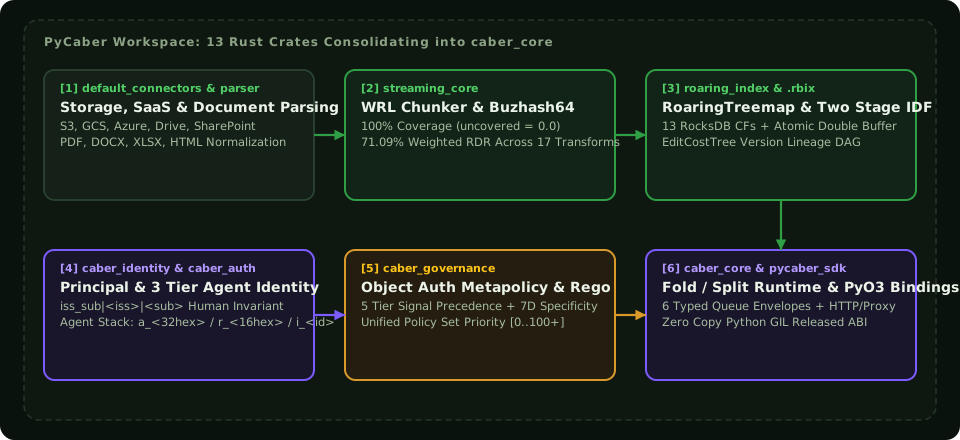
This page provides the micro level technical reference for public functions, classes, decorators, and exceptions exposed by the pycaber Python package and its transparent instrumentation engine pycaber.auto.
configure
Configures pycaber and logs all native and Python component versions.
- Syntax:python
pycaber.configure(*args, **kwargs) -> None - Parameters:
*args: Positional arguments passed to internal configuration loaders.**kwargs: Key value configuration overrides. Accepted keys includeapi_key(string),caber_host(string),redact_enabled(boolean), anddebug(boolean).
- Return Value:
None. - Behavior & Environment: Initializes the native Rust telemetry engine, establishes HTTP or Unix domain socket transport to
caber_core, readsCSI_API_KEYandCSI_CABER_HOSTenvironment variables, and configures fallback logging. Must be invoked before importing user modules when running outside ofcaber-run.
uninstrument
Removes all Caber runtime monkey patches and restores original library functions.
- Syntax:python
pycaber.uninstrument() -> None - Parameters: None.
- Return Value:
None. - Behavior: Restores original unpatched functions across
requests,httpx,urllib3,aiohttp,psycopg, andredis. Cleanly disablespycaber.autowithout restarting the process.
get_patched_modules
Returns the set of module names currently monkey patched by pycaber.auto.
- Syntax:python
pycaber.get_patched_modules() -> set[str] - Parameters: None.
- Return Value:
set[str]: Set containing active patched module names (for example{"requests", "httpx", "urllib3"}).
native_abi_report
Audits capability and binary compatibility of the native Rust extension exports.
- Syntax:python
pycaber.native_abi_report(module: Any = None) -> dict[str, AbiVerdict] - Parameters:
module(Any, optional, default:None): Optional module reference to audit. Defaults to internal native extension.
- Return Value:
dict[str, AbiVerdict]: Mapping of export names to verdict objects with fieldsok: boolanddetail: str.
2. WebSocket & On Behalf Of (OBO) Session Tracking
set_ws_user
Pins the human user identity for the current WebSocket connection context.
- Syntax:python
pycaber.set_ws_user( *, subject: str, issuer: str, email: str | None = None, authenticator: str | None = None, acceptor: str | None = None, session: str | None = None, email_verified: bool = False ) -> str - Parameters:
subject(str, keyword only, required): User identity subject identifiersubfrom the IdP.issuer(str, keyword only, required): Identity provider issuer URL or identifierissconforming to RFC 9493.email(str | None, keyword only, optional, default:None): Acting user email address. Passed to native Rust engine asacting_emailfor directory lookup fallback.authenticator(str | None, keyword only, optional, default:None): Evidence provenance origin. Defaults toissuer.acceptor(str | None, keyword only, optional, default:None): Target service host. Defaults to connection host.session(str | None, keyword only, optional, default:None): Explicit session identifier override.email_verified(bool, keyword only, optional, default:False): Whether the IdP verified the email claim (for example OIDCemail_verified).
- Return Value:
str: Uniquepin_idtoken identifying this user pin.
- Exceptions:
TypeError: Raised ifissuerorsubjectis omitted.ValueError: Raised ifissuerorsubjectis empty string.
- Behavior: Pins human identity to the active WebSocket connection. Sets
ctx.userand outboundcaber.userbaggage header to canonical formatiss_sub|<issuer>|<subject>. Once set, automatic resolvers and outbound feedback cannot override identity until released viaclear_ws_user().
clear_ws_user
Releases a user identity pin previously registered via set_ws_user().
- Syntax:python
pycaber.clear_ws_user(pin_id: str) -> bool - Parameters:
pin_id(str, required): Pin token returned byset_ws_user().
- Return Value:
bool:Trueif the pin was located and released;Falseifpin_idwas unknown or expired.
- Behavior: Unpins only the specific connection holding
pin_id. Delegates directly to native RustConnectionHandle.unpin_user().
terminate_ws_user
Clears user pinning for the current WebSocket connection without requiring a pin identifier.
- Syntax:python
pycaber.terminate_ws_user() -> bool - Parameters: None.
- Return Value:
bool:Trueif active connection user was unpinned;Falseif no WebSocket context was active.
mark_all_ws_responded
Closes out all open OBO request sessions for the current WebSocket connection.
- Syntax:python
pycaber.mark_all_ws_responded() -> int - Parameters: None.
- Return Value:
int: Number of expired or closed session entries, or0if no WebSocket context is active.
- Behavior: In registered content mode, purges unclaimed Rust side interaction buffer entries. In standard mode, expires stale request side
n-merrows.
register_request
Registers meaningful request content for On Behalf Of (OBO) chain tracking and user intent attribution.
- Syntax:python
pycaber.register_request(content: str, *, api: str | None = None, emit_synthetic: bool = True) -> InteractionHandle - Parameters:
content(str, required): The meaningful content string (for example the end user prompt, query text, or tool input).api(str | None, keyword only, optional, default:None): ApiMap host identifier to target. Defaults to the current active WebSocket connection host.emit_synthetic(bool, keyword only, optional, default:True): IfTrue, emits a synthetic OBO entry if pending registration expires without an observed match.
- Return Value:
InteractionHandle: Opaque handle object tying this registered request to its downstream response viaregister_response().
- Behavior: Matches
contentagainst buffered incoming WebSocket messages using exact normalized substring matching with decoded text preference. Executes non blockingly. If the incoming message has not yet arrived, registers as pending and resolves when the message flows through the interceptor.
register_response
Registers response content and closes the active OBO interaction chain.
- Syntax:python
pycaber.register_response(content: str, *, interaction: InteractionHandle | None = None, emit_synthetic: bool = True) -> bool - Parameters:
content(str, required): The response content string (for example LLM output text, completion token stream, or final answer).interaction(InteractionHandle | None, keyword only, optional, default:None): Handle returned by a priorregister_request()call.emit_synthetic(bool, keyword only, optional, default:True): IfTrue, emits a synthetic OBO response record if pending expires without match.
- Return Value:
bool:Trueif registration succeeded (match completed or pending registration created);Falseotherwise.
- Behavior: Matches
contentagainst buffered outgoing messages. If the outgoing message has not been transmitted yet, registers as pending and resolves when the message flows through the interceptor.
3. Live Redaction & Privacy Controls
set_redact_enabled
Toggles payload redaction at runtime without restarting the application process.
- Syntax:python
pycaber.set_redact_enabled(enabled: bool) -> None - Parameters:
enabled(bool, required):Trueto enforce live payload redaction;Falseto enter observation only mode.
- Return Value:
None. - Exceptions:
RuntimeError: Raised if called beforepycaber.configure()has initialized native runtime configuration.
- Behavior: Mutates native
global.redact_enabledatomic flag. Per APIredactStrategysettings are preserved. Runtime toggle persists across configuration reloads unless new configuration explicitly definesGLOBAL.redactEnabled.
reset_redact_enabled
Re resolves the redaction state from environment variable CSI_GLOBAL_REDACT_ENABLED.
- Syntax:python
pycaber.reset_redact_enabled() -> None - Parameters: None.
- Return Value:
None. - Exceptions:
RuntimeError: Raised if called beforepycaber.configure()has initialized runtime configuration.
- Behavior: Re reads environment variable
CSI_GLOBAL_REDACT_ENABLED, falls back toGLOBAL.redactEnabledin configuration, or defaults toTrue.
is_redact_enabled
Returns the current global redaction state.
- Syntax:python
pycaber.is_redact_enabled() -> bool - Parameters: None.
- Return Value:
bool:Trueif redaction mutations are active;Falseif operating in observation only mode.
- Exceptions:
RuntimeError: Raised if the installed native extension lacks redaction state accessors.
4. Agent Tool Interception & Framework Adapters
tool
Decorator syntax for wrapping custom Python functions exposed to AI agents.
- Syntax:python
@pycaber.tool( *, name: str = "", framework: str = "custom", data_domain: str = "", allowed_purposes: list[str] | None = None, captures_output: bool = True, prompt_allowed: bool | None = None, memory_allowed: bool | None = None, metadata: Mapping[str, Any] | None = None, output_rewriter: OutputRewriter | None = None ) -> Callable[[Callable[..., Any]], Callable[..., Any]] - Parameters:
name(str, keyword only, optional, default:""): Tool display name.framework(str, keyword only, optional, default:"custom"): Origin framework.data_domain(str, keyword only, optional, default:""): Data domain classification tag.allowed_purposes(list[str] | None, keyword only, optional, default:None): Declared legitimate purpose list for privacy enforcement.captures_output(bool, keyword only, optional, default:True): Whether tool return values should be captured and redacted.prompt_allowed(bool | None, keyword only, optional, default:None): Whether output may flow into prompt context.memory_allowed(bool | None, keyword only, optional, default:None): Whether output may be committed to long term agent memory.metadata(Mapping[str, Any] | None, keyword only, optional, default:None): Custom metadata dictionary.output_rewriter(OutputRewriter | None, keyword only, optional, default:None): In place object rewriter.
- Return Value: Decorator wrapping the function with
wrap_callable.
wrap_callable
Wraps a local callable as an interceptable internal agent action.
- Syntax:python
pycaber.wrap_callable( fn: Callable[..., Any], *, framework: str = "custom", event_type: str = "ToolInvoked", action_name: str = "", action_type: str = "tool", metadata: Mapping[str, Any] | None = None, user: str = "", session_id: str = "", output_rewriter: OutputRewriter | None = None ) -> Callable[..., Any] - Parameters:
fn(Callable[..., Any], required): Target callable function to wrap.framework(str, keyword only, optional, default:"custom"): Framework origin tag.event_type(str, keyword only, optional, default:"ToolInvoked"): Audit event category.action_name(str, keyword only, optional, default:""): Name of the action. Defaults tofn.__name__.action_type(str, keyword only, optional, default:"tool"): Action classification string.metadata(Mapping[str, Any] | None, keyword only, optional, default:None): Key value context claims.user(str, keyword only, optional, default:""): Pinned user identifier.session_id(str, keyword only, optional, default:""): Correlation session identifier.output_rewriter(OutputRewriter | None, keyword only, optional, default:None): Optional callback enabling in place mutation of typed return objects.
- Return Value: Wrapped callable with identical parameter signature.
- Behavior: Intercepts invocation arguments for redaction before execution. Executes function. Intercepts return result or error for redaction and telemetry event emission.
process_agent_action
Processes a complete internal action through the synchronous interception pipeline.
- Syntax:python
pycaber.process_agent_action(capture: AgentActionCapture) -> tuple[Any, Any] - Parameters:
capture(AgentActionCapture, required): Action descriptor carrying input, output, and trace metadata.
- Return Value:
tuple[Any, Any]: Pair containing(redacted_input, redacted_output).
process_agent_action_async
Asynchronous variant of process_agent_action.
- Syntax:python
async pycaber.process_agent_action_async(capture: AgentActionCapture) -> tuple[Any, Any] - Parameters:
capture(AgentActionCapture, required): Action descriptor.
- Return Value:
- Coroutine resolving to
tuple[Any, Any].
- Coroutine resolving to
register_state_resolver
Registers a custom framework state resolver for extracting application context.
- Syntax:python
pycaber.register_state_resolver( name: str, resolver: Callable[[Any], ResolvedState] ) -> None - Parameters:
name(str, required): Unique framework identifier (for example"streamlit","langgraph","crewai").resolver(Callable[[Any], ResolvedState], required): Callback receiving handler or connection instance and returningResolvedState.
- Return Value:
None.
unregister_state_resolver
Removes a previously registered framework state resolver.
- Syntax:python
pycaber.unregister_state_resolver(name: str) -> None - Parameters:
name(str, required): Framework identifier to remove.
- Return Value:
None.
5. Core Classes & Data Models
AgentActionCapture
Dataclass representing framework native action data prepared for Caber interception.
- Syntax:python
@dataclass class AgentActionCapture: framework: str event_type: str action_name: str = "" action_type: str = "" input_data: Any = None output_data: Any = None error: str = "" status_code: int = 200 metadata: dict[str, Any] = field(default_factory=dict) user: str = "" session_id: str = "" trace_id: str = "" span_id: str = "" api_host: str = "" api_path: str = "" - Field Definitions:
framework(str): Name of calling framework (for example"langchain","autogen","custom").event_type(str): Event category (for example"ToolInvoked","ChainExecuted").action_name(str): Target tool or action identifier.action_type(str): Category classification (for example"tool","retriever","prompt").input_data(Any): Action arguments forming the synthetic request body.output_data(Any): Action return value forming the synthetic response body.error(str): Exception message if execution failed.status_code(int): Synthetic HTTP response status code (default:200, error:500).metadata(dict[str, Any]): Arbitrary key value security and context attributes.user(str): Pinned user identifier string.session_id(str): Correlation session identifier.trace_id(str): OpenTelemetry hex trace identifier.span_id(str): OpenTelemetry hex span identifier.api_host(str): Synthetic API host identifier.api_path(str): Synthetic API endpoint path.
AgentActionState
Mutable correlation state tracking an in flight synthetic request response pair.
- Syntax:python
@dataclass class AgentActionState: capture: AgentActionCapture action_id: str trace_id: str span_id: str parent_span_id: str = "" started_at: float = field(default_factory=time.time) request_result: Any = None - Field Definitions:
capture(AgentActionCapture): Underlying action descriptor.action_id(str): Unique action identifier.trace_id(str): Correlation trace identifier.span_id(str): In flight span identifier.parent_span_id(str): Parent context span identifier.started_at(float): Unix timestamp marking start of execution.request_result(Any): Native result cached from request stage to pass to response stage.
ResolvedState
Standardized container for application level state resolved by framework adapters.
- Syntax:python
@dataclass class ResolvedState: user: str = "" thread_id: str = "" agent_id: str = "" task_id: str = "" correlation_id: str = "" extra: dict[str, str] = field(default_factory=dict) - Field Definitions:
user(str): Human or service account principal.thread_id(str): Conversation thread identifier.agent_id(str): Framework agent instance identifier.task_id(str): Scheduled task or workflow step identifier.correlation_id(str): Distributed correlation identifier.extra(dict[str, str]): Additional framework specific attributes.
CaberWSGIMiddleware
WSGI standard middleware for intercepting and redacting inbound HTTP requests in Flask and Django.
- Syntax:python
class CaberWSGIMiddleware: def __init__(self, app: Callable): ... def __call__(self, environ: dict, start_response: Callable) -> Iterable[bytes]: ... - Usage:python
app.wsgi_app = CaberWSGIMiddleware(app.wsgi_app)
CaberASGIMiddleware
ASGI standard middleware for intercepting and redacting inbound HTTP and WebSocket requests in FastAPI and Starlette.
- Syntax:python
class CaberASGIMiddleware: def __init__(self, app: Callable): ... async def __call__(self, scope: dict, receive: Callable, send: Callable) -> None: ... - Usage:python
app.add_middleware(CaberASGIMiddleware)
CaberLangChainCallbackHandler
Lifecycle observer attaching Caber audit telemetry to LangChain chains, tools, and agents.
- Syntax:python
class CaberLangChainCallbackHandler(BaseCallbackHandler):
    def on_chain_start(self, serialized: dict[str, Any], inputs: dict[str, Any], **kwargs: Any) -> None: ...
    def on_chain_end(self, outputs: dict[str, Any], **kwargs: Any) -> None: ...
    def on_chain_error(self, error: BaseException, **kwargs: Any) -> None: ...
    def on_tool_start(self, serialized: dict[str, Any], input_str: str, **kwargs: Any) -> None: ...
    def on_tool_end(self, output: str, **kwargs: Any) -> None: ...
    def on_tool_error(self, error: BaseException, **kwargs: Any) -> None: ...
6. Exceptions
RedactionUnavailable
Raised when a response payload cannot obtain a redaction verdict from caber_core and fail closed security is enforced.
- Syntax:
class RedactionUnavailable(RuntimeError): ... - Behavior: Propagates through user applications to prevent raw uninspected sensitive data leakage.